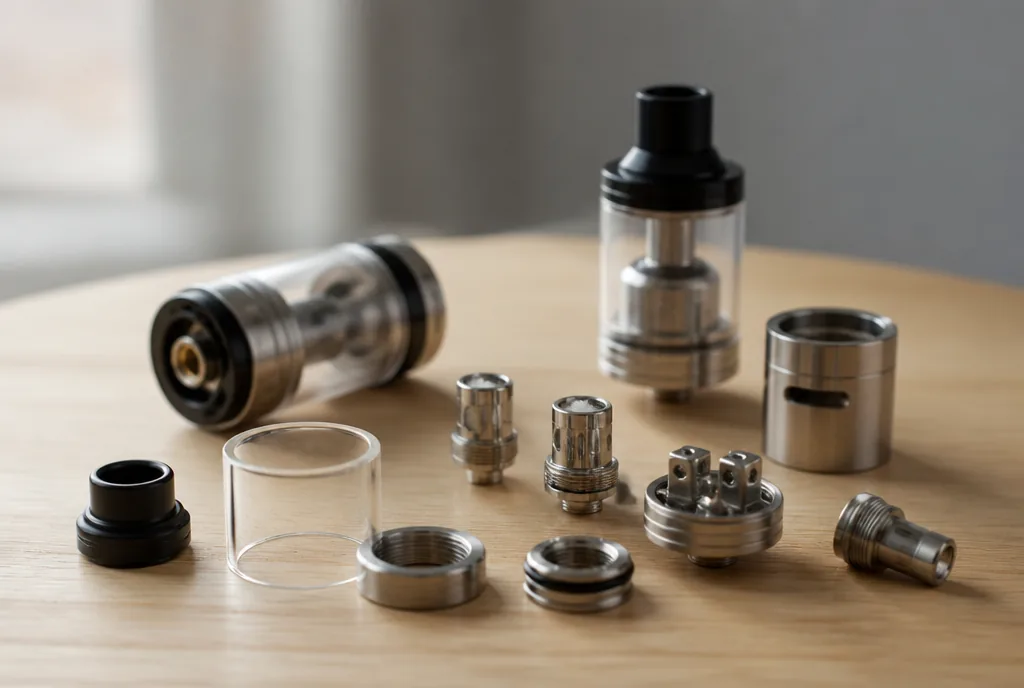
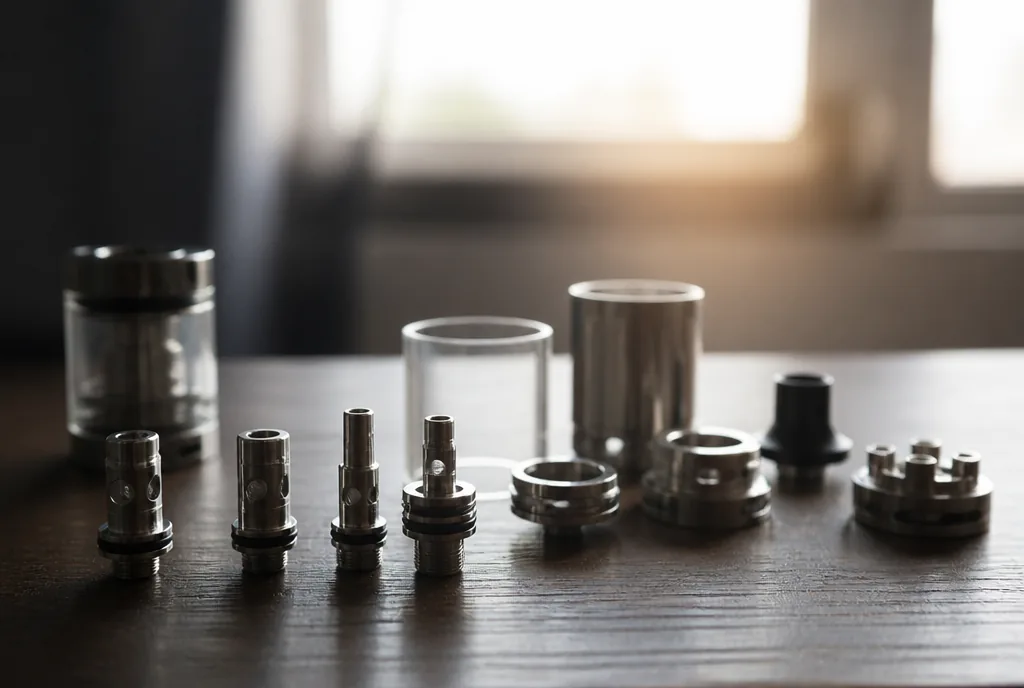
Geekvape coils: which series fits which tank
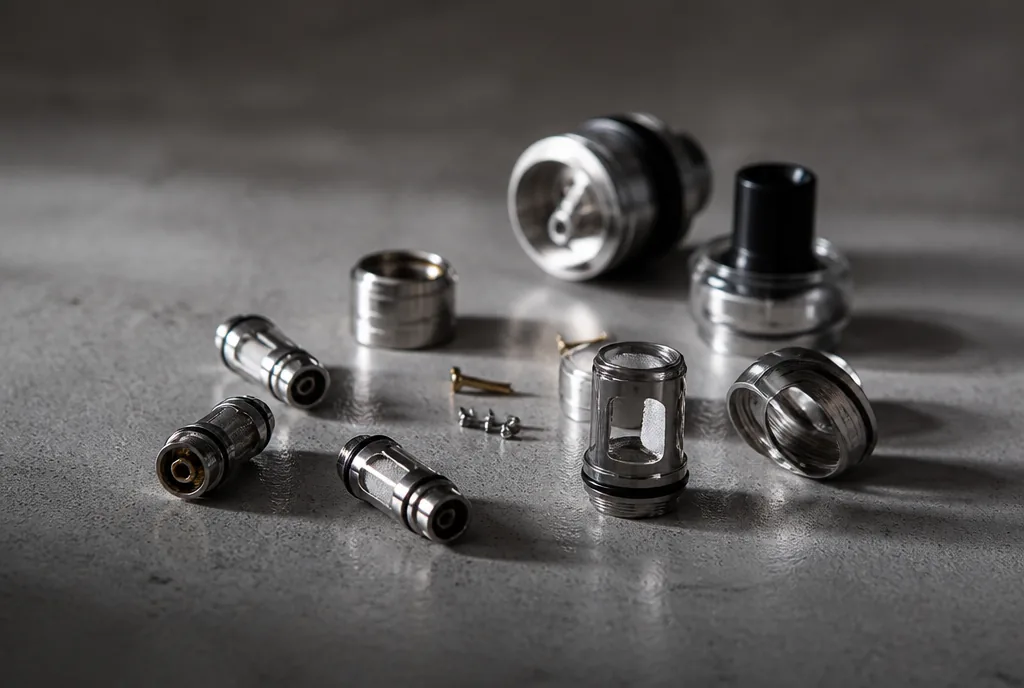
On a product page, the same 0.4 ohm value exists in several versions from this manufacturer, and exactly one of them goes into your tank. Choosing between Geekvape coils therefore starts with identifying a letter, not a resistance. B, J, M, P and Z are not quality tiers, they are separate mechanical formats. Getting it wrong means buying a pack of five parts you cannot use.
Which Geekvape coils suit which hardware
The rule fits in one sentence: the series is dictated by the tank, the resistance in ohms is dictated by the way you vape. The order matters, because a perfect value in the wrong series will never physically mount.
Here is the main correspondence between hardware families and the manufacturer’s coil series:
- Zeus Tank, Z Fli, Z Fli 2, Z SE, Obelisk Tank and P Subohm Tank: Z series.
- Aegis Boost pods and Z Nano tanks: B series.
- Pods in the Digi range, including Digi Pro and Digi Max: J series.
- Z Max Tank: M series.
British retailers are unusually blunt about this, and one of the largest states in capitals on its own Z series listing that these coils do not fit the Z Max Tank, which takes M series, nor the Z Nano 2, which takes B series. That warning exists because the mistake is made constantly.
Once the series is identified, the remaining work is to pick the resistance value and then check that the wattage range published by the manufacturer sits inside what your device can actually do.
The series, one by one
Each series corresponds to its own connection base and its own diameter. The values available vary a great deal from one to the next, and that spread says a lot about the use the maker had in mind. The three families below cover most of the hardware in circulation in Britain.
The Z series is the widest catalogue of the lot and is aimed squarely at direct lung vaping. The current XM Boost versions come in 0.15 ohm published between 70 and 85 W, 0.2 ohm between 70 and 80 W and 0.4 ohm between 50 and 60 W. A Z Dual in 0.25 ohm is added to that, published between 45 and 57 W.
All of them use a mesh heating strip, Kanthal type wire and organic cotton. Retailers here recommend a liquid rich in vegetable glycerine, somewhere between 30/70 and 0/100, to limit liquid creeping back up the chimney.
The B series is the most versatile of the range, because it covers both a loose direct draw and a tight one. It holds Boost values in 0.2, 0.3, 0.4 and 0.6 ohm, then two markedly higher references in 0.8 and 1.2 ohm identified as mouth to lung.
That gap is not a detail. A pod compatible with the B series can change behaviour completely without changing hardware at all, simply by moving from a 0.3 ohm to a 1.2 ohm. It is the cheapest way to try a different style of vaping with what you already own.
The M series equips the Z Max Tank with very low values from 0.14 to 0.3 ohm. The single mesh 0.14 ohm is published between 60 and 80 W, the double mesh 0.3 ohm between 55 and 65 W.
The P series offers 0.15 XM, 0.2, 0.4 and 0.5 ohm, while the J series, dedicated to the Digi pods, covers the widest span with six values from 0.2 to 1.2 ohm. British compatibility guides usually lay these out alongside a Q series as well, which is worth knowing before you assume a chart is complete.
What the resistance value really changes
The letter decides compatibility, the value decides sensation. A low resistance heats a large surface and demands power, a high resistance heats very little and is satisfied with a handful of watts.
The link between the two is measurable rather than a matter of taste. At a power P and a resistance R, the voltage across the coil is the square root of P multiplied by R. A 0.25 ohm at 50 W therefore works at roughly 3.5 V, while a 0.4 ohm at 55 W sits nearer 4.7 V.
That arithmetic explains why one device does not drive every value in the same way, and why the manufacturer range is worth respecting rather than rounding off at random. What the setting then asks of the power source is a separate question, and one we take apart in our reading of the Aegis Solo 3 and its hundred watts.
Reading the wattage ranges on Geekvape coils
A box of these coils shows two numbers: a value in ohms, which is a physical property, and a bracket in watts, which is a setting recommendation. The relationship between them can be calculated, and it follows a consistent logic across the whole catalogue.
Translated into voltage, those brackets tighten noticeably. A 0.15 ohm moves from about 3.24 V at 70 W to 3.57 V at 85 W. A 0.25 ohm runs from 3.35 V at 45 W to 3.77 V at 57 W. The 0.14 ohm in the M series stays between roughly 2.90 and 3.35 V across its entire published span.
The manufacturer is therefore not building its recommendations around a wattage but around a voltage window. That is what explains why a higher value asks for far fewer watts without heating any less fiercely at the wire.
Then there is liquid flow. Below the lower figure, the liquid is not properly vaporised and works its way back up the chimney. Above the upper figure, the cotton dries out faster than the tank can resupply it, and since British tanks are capped at 2 ml the reservoir has less in hand to begin with.
Three compatibility traps worth knowing
Buying mistakes rarely come from the value chosen. They come almost always from a naming detail that product pages print in small type. Three cases recur.
- The Z 0.25 ohm Dual does not go into the P Subohm Tank, even though the rest of the Z series does. It is the least publicised exception in the catalogue.
- The XM and XM Boost labels denote successive revisions of one series, with widened liquid feed. The published wattage ranges are not identical from one revision to the next.
- Two series can display exactly the same value. A 0.2 ohm in the B series and a 0.2 ohm in the Z series are not interchangeable for that reason alone.
The useful habit is to note the full reference printed on the old part before ordering, letter included, rather than the resistance value on its own. The same discipline applied to another manufacturer runs through our guide to the Voopoo PnP platforms.
Priming: what happens in the first ten minutes
A new coil arrives with dry cotton. Retailers recommend filling the tank and then waiting ten to fifteen minutes before the first puff, the time the fibre needs to soak through completely rather than only at the surface.
Placing a few drops directly onto the side wicking ports speeds the process up considerably. The first puffs are then taken at reduced power, at the bottom of the published bracket, before working upward over several draws.
Skipping that step produces an immediate and permanent burnt taste on the part concerned. It is the most common reason a coil ends up in the bin, and by some distance the most avoidable.
Frequently asked questions
Can a coil from this range be cleaned and reused?
Rinsing removes some of the deposits but restores neither the cotton nor the geometry of the mesh. Flavour drops away again quickly. These parts remain consumables.
What exactly does the Boost label mean?
It identifies a revision of the series, with reworked liquid intakes. It does not change the mounting format, only the published characteristics.
Can another brand of coil go into a Zeus Tank?
Some third party parts advertise Z series compatibility. The base has to be strictly identical, keying included, otherwise the seal cannot be relied on.
Should the device be set in watts or in volts with these coils?
Watt mode is the more readable of the two, since the manufacturer brackets are published in watts. Volt mode adds nothing on a recent regulated device.
Do very low values use more liquid?
Yes, mechanically. A larger heating surface fed by a higher wattage vaporises more liquid on every puff.
Get the series right before the value
The catalogue looks dense as long as you read it through the numbers. Read through the letters it becomes a simple map: each tank calls for a series, each series offers its own bracket of values. Choosing between Geekvape coils therefore comes down to validating a compatibility first, then adjusting a sensation.
That is the same reasoning that structures every piece of modular vaping hardware sold here, mechanics first and settings second, and it is exactly how we approach the Zeus range and its revisions.
Editorial content for adult readers only. Vaping products usually contain nicotine, a substance that causes addiction. Not for sale to under-18s in the United Kingdom. This article is not a buying recommendation.