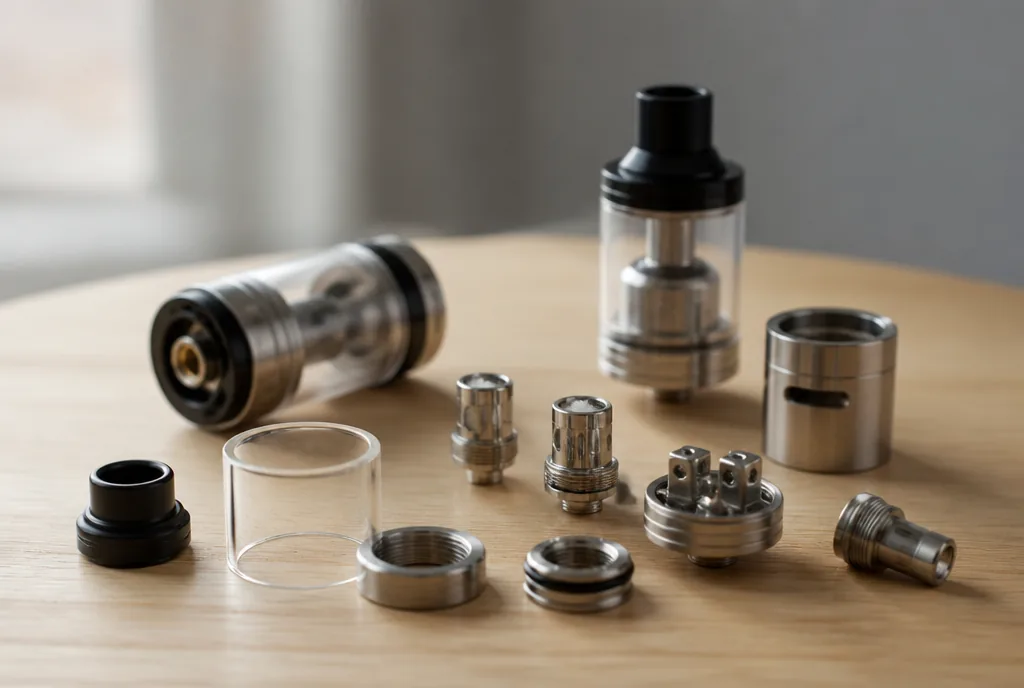
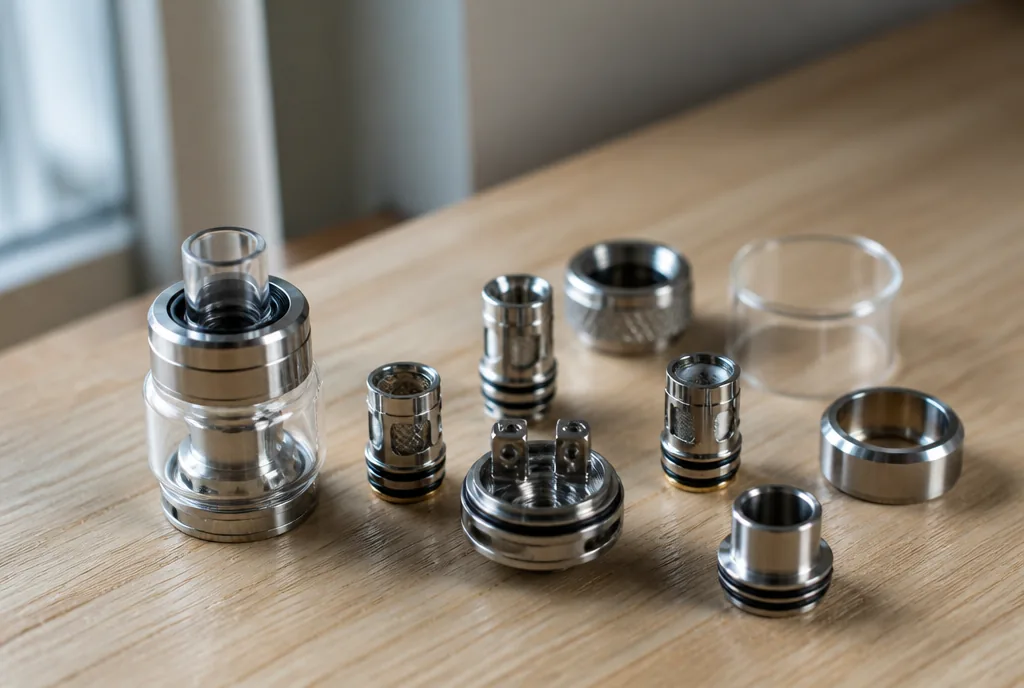
Zeus coils: decoding the values and wattages
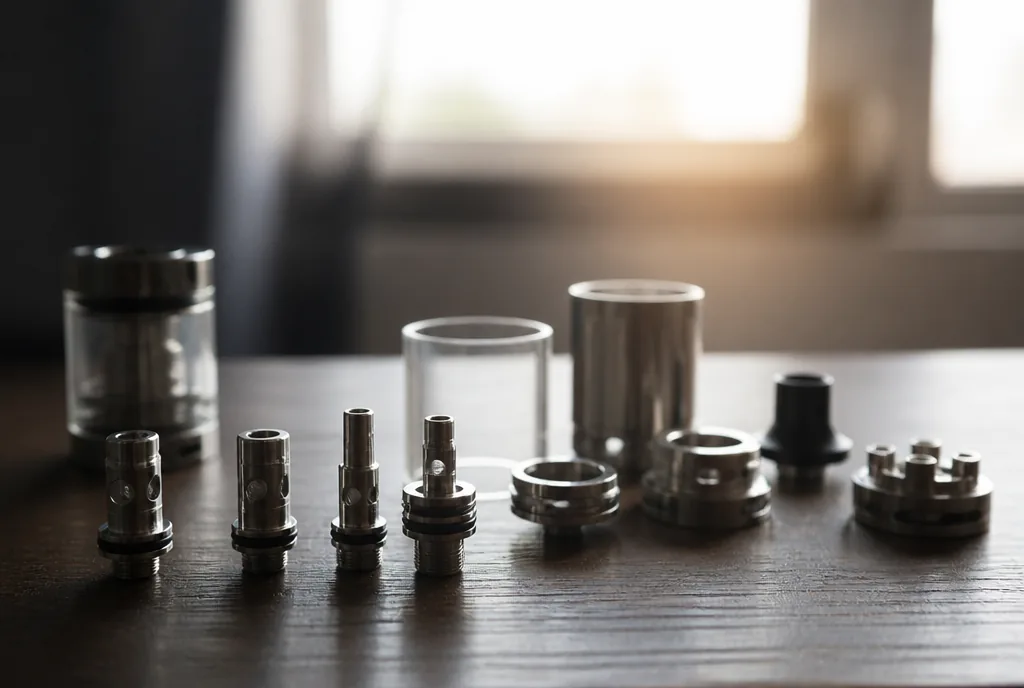
Four values, three different labels on the packaging, and wattage brackets that vary from one British retailer to the next for what looks like the same product. The range of Zeus coils is a textbook case.
Under a name that has been stable for years, the manufacturer has revised the part three times without changing what it is called commercially. The published figures followed, and not always in the direction you would expect.
Which Zeus coils for which wattage
The XM Boost versions, currently the most widely distributed here, come in four values with precise brackets. Those are the reference points on a recent Zeus Tank.
- 0.15 ohm XM Boost: 70 to 85 W.
- 0.2 ohm XM Boost: 70 to 80 W.
- 0.25 ohm Dual: 45 to 57 W.
- 0.4 ohm XM Boost: 50 to 60 W.
All of them target direct lung inhalation, with a mesh heating strip, Kanthal type wire and organic cotton. The 0.4 ohm remains the most accessible for a modest device, the 0.15 ohm the most demanding of the four by a clear margin.
One British naming point is worth clearing up straight away, because it causes more confusion than the revisions do. Retailers here now list the range as Z series, noting on their own pages that these were formerly known as Zeus coils. The connection has not changed, only the catalogue heading, so a search for the old name and a search for the new one land on the same shelf.
Z, Z XM and XM Boost: three revisions, three brackets
The letter Z names the platform, not the generation. Over the last decade the same connection has received several versions of the heating strip, each with its own recommendations. That is the main source of the contradictory figures you meet online.
The XM versions are distinguished by widened liquid feed ports. Retailers present that evolution as a way of roughly doubling longevity compared with the original Z series, particularly with thick or heavily sweetened liquids.
The Boost label identifies the revision that followed, with reworked cotton and a strip described as more durable under sustained power. The mounting format has not moved at all: an XM Boost part installs exactly like a first generation Z.
Why Zeus coils listings disagree with each other
The same displayed value therefore does not refer to the same part depending on the generation being sold. At 0.15 ohm, some retailers publish 80 to 90 W for the original Z version, while the XM version is given between 70 and 85 W.
The gap is not a typing error. A more generous liquid feed lowers the saturation threshold of the cotton, which allows the recommended upper figure to come down while more vapour is produced, not less.
The practical conclusion is short. The bracket to respect is the one printed on the box you are holding, not the one memorised from a previous purchase. That is also why the seven or so entries on a British Z series page are not seven different products so much as one product across several revisions.
The P Subohm Tank compatibility exception
The Z series covers a wide fleet: Zeus Tank, Z Fli, Z Fli 2, Z SE, Obelisk Tank and P Subohm Tank on the tank side, plus the Aegis Legend, Aegis Max and Aegis Solo kits that ship with them. British retailers add the later Legend and the larger tanks to that list.
One reference escapes that general compatibility. The 0.25 ohm Dual does not go into the P Subohm Tank, even though it works on every other reservoir on the list.
It is an exception rarely mentioned on product pages, and it concerns precisely the most versatile value in the range. The wider question of series and their bases is covered in our guide to the Geekvape coil series.
What these values mean in electrical terms
Translating a bracket into electrical quantities clarifies the choice immediately. The voltage applied across the coil is the square root of the power multiplied by the resistance, which is arithmetic you can run on any published pair of figures.
A 0.15 ohm at 85 W therefore works at around 3.57 V. A 0.25 ohm at 57 W sits at roughly 3.77 V. A 0.4 ohm at 60 W climbs to about 4.90 V, which is the highest voltage of the three despite being the least demanding value overall.
That is the instructive paradox of the range. The highest resistance works under the highest voltage while asking the least of the low voltage side of the circuit. On the source side, though, it is the wattage alone that counts, and 85 W remains 85 W to supply whatever the value fitted.
What that demand means for the cell in your device is not something a coil packet can answer. The figure that settles it is published by the cell manufacturer, in the datasheet for the exact model reference, on the continuous discharge line.
Read that document rather than the number printed on the wrap, since rewrapped cells circulate widely and a wrap can advertise a rating the cell was never given.
Around that reading sit four habits worth keeping. Buy cells as a matched pair and keep them paired for life if a device takes two. Retire any cell with a nicked wrap or a damaged insulating ring instead of taping it.
Carry spares in a rigid case rather than loose in a pocket, and charge on a charger designed for the format and chemistry in question. The full reasoning is developed in our reading of the Aegis Solo 3 and its hundred watts.
Choosing a value according to your device
The question asked in shops is almost always the same one: which value to take. The answer depends less on taste than on the wattage the device can hold for a whole session rather than for a single puff.
A device limited to 60 W will never feed a 0.15 ohm properly, since its published lower figure sits at 70 W. The result is a lukewarm vape and spitting, without the coil being at fault in any way.
On a single cell device the 0.25 and 0.4 ohm values remain the more sensible pair. They call for 45 to 60 W, which leaves genuine headroom rather than pushing everything to its published limit.
The 0.15 and 0.2 ohm values come into their own on a two cell device, where the higher available voltage makes the upper end of the range a far less strained proposition. That is a hardware decision as much as a flavour one.
Liquid, the forgotten variable
A coil in this range cannot be set independently of the liquid feeding it. The wide feed ports of the series call for bases rich in vegetable glycerine, put by British retailers somewhere between 30/70 and 0/100.
A liquid that is too thin crosses the cotton faster than it is vaporised and works its way up the chimney. The symptom is unmistakable: spitting in the mouth and a tank that empties for no visible reason.
Conversely, a very thick liquid paired with a wattage at the bottom of the bracket circulates badly. Flavour goes flat and the part fouls up faster, without the setting itself being the problem.
Frequently asked questions
How long does one of these coils last in everyday use?
It depends on the liquid, the wattage and the rhythm. British retailers quote an order of magnitude of one to two weeks for a consumable of this type, which is not a rule for any particular use.
Can a Z part be used on an Obelisk Tank?
Yes, the Obelisk Tank is among the reservoirs compatible with this series. The value is then chosen according to the power available on the device.
Should you change coil when you change flavour?
It is not compulsory, but a very sweet liquid leaves deposits that carry into the next flavour. Many vapers dedicate one part to that kind of profile.
Is the tool supplied with the tank meant for replacement?
It helps extract a part that resists after prolonged use. The fitting itself is done by hand, guided by the keying on the base.
Does a lower value always produce more vapour?
Not mechanically. Vapour is produced by the power applied and the heating surface, while the resistance in ohms only determines the voltage required to get there.
Read the box before you set the device
The range looks unstable as long as you read it by its commercial name alone. Taken generation by generation it becomes perfectly legible: a label on the packaging, an associated bracket, and a value in ohms that fixes the working voltage.
Setting up Zeus coils then comes down to respecting that trio and adjusting by a few watts according to the liquid in the tank. It is the approach that works for any vaping consumable whose name outlives its technical revisions, and the same one we apply to the Voopoo PnP platforms.
Editorial content for adult readers only. Vaping products usually contain nicotine, a substance that causes addiction. Not for sale to under-18s in the United Kingdom. This article is not a buying recommendation.